Hazel Eyes: Color, Rarity, Meaning & Examples
Hazel eyes are mixed eyes: green, brown, gold, and amber tones can appear in the same iris. Learn what hazel eyes look like, why they seem to change color, how rare they are, and how to tell hazel from green, brown, or amber eyes.
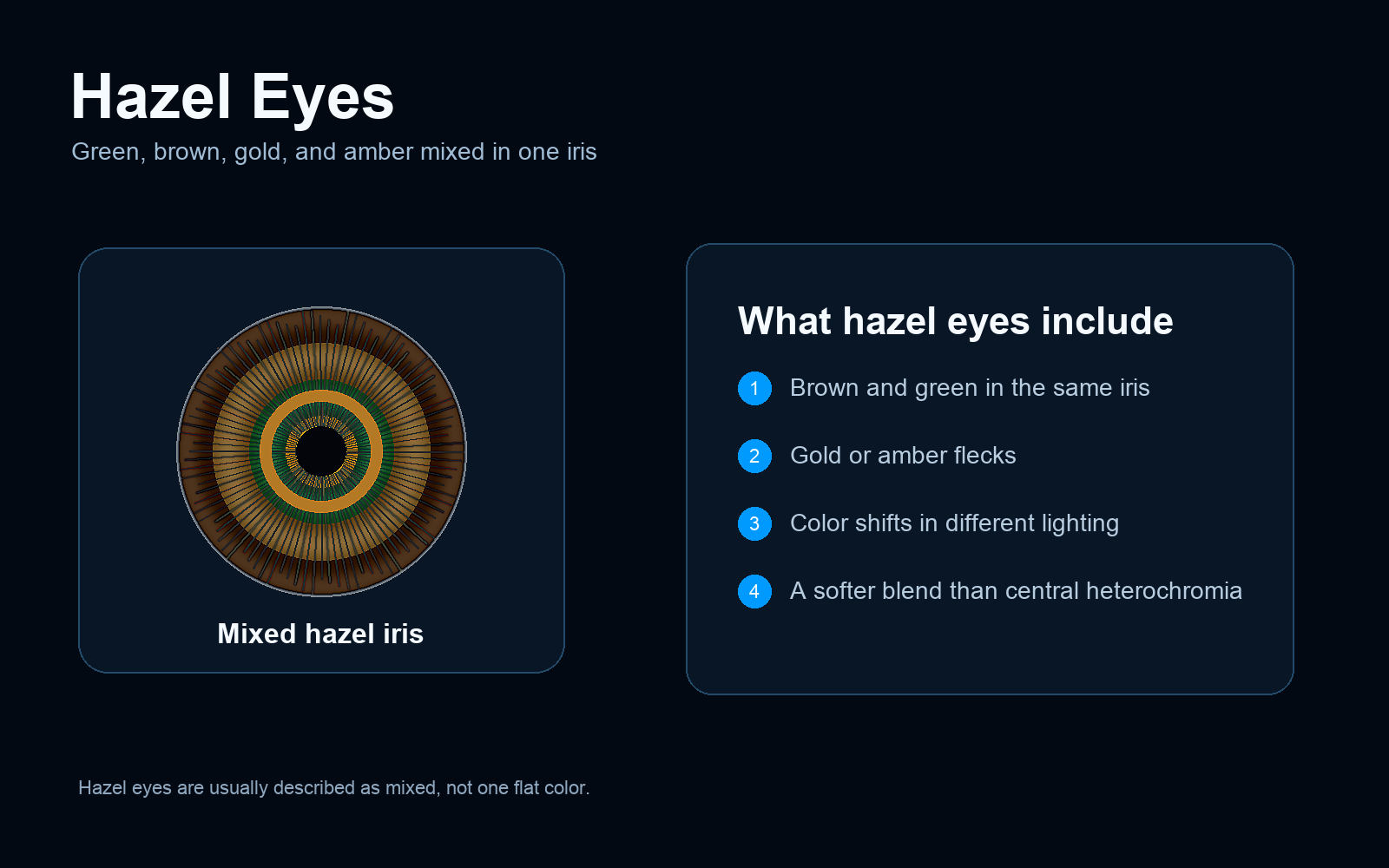
Hazel eyes are one of the hardest eye colors to label because they are rarely one clean shade. In daylight they may look green and gold. Indoors they may look brown. In a close-up photo, you may see several colors layered together.
The simplest definition is this: hazel eyes contain a visible mix of brown and green, often with gold or amber flecks. If one color fully dominates with very little variation, the eyes may be better described as brown, green, amber, gray, or blue instead.
What Color Are Hazel Eyes?
Hazel eyes are usually a blend of green, brown, gold, and amber. The exact mix can vary from person to person. Some hazel eyes look mostly brown with green around the edge. Others look mostly green with brown or gold near the pupil.
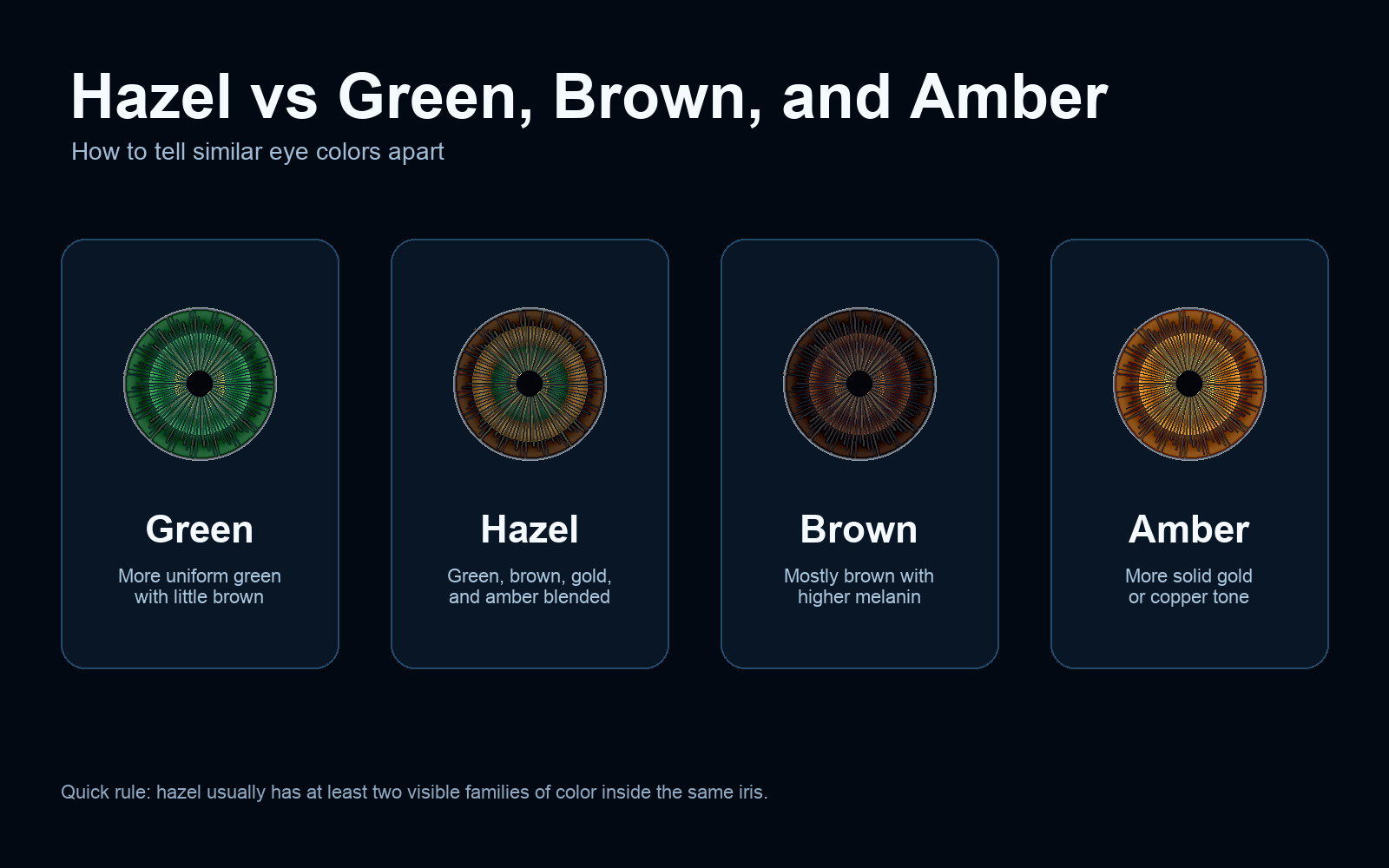
That mixed structure is what makes hazel different from a single-color eye. Brown eyes are usually more uniform. Green eyes are usually more consistently green. Amber eyes are usually more solid gold or copper. Hazel sits between those categories.
Quick rule: if you see both green and brown in the same iris, with gold or amber tones mixed in, hazel is probably the closest everyday label.
Types of Hazel Eyes
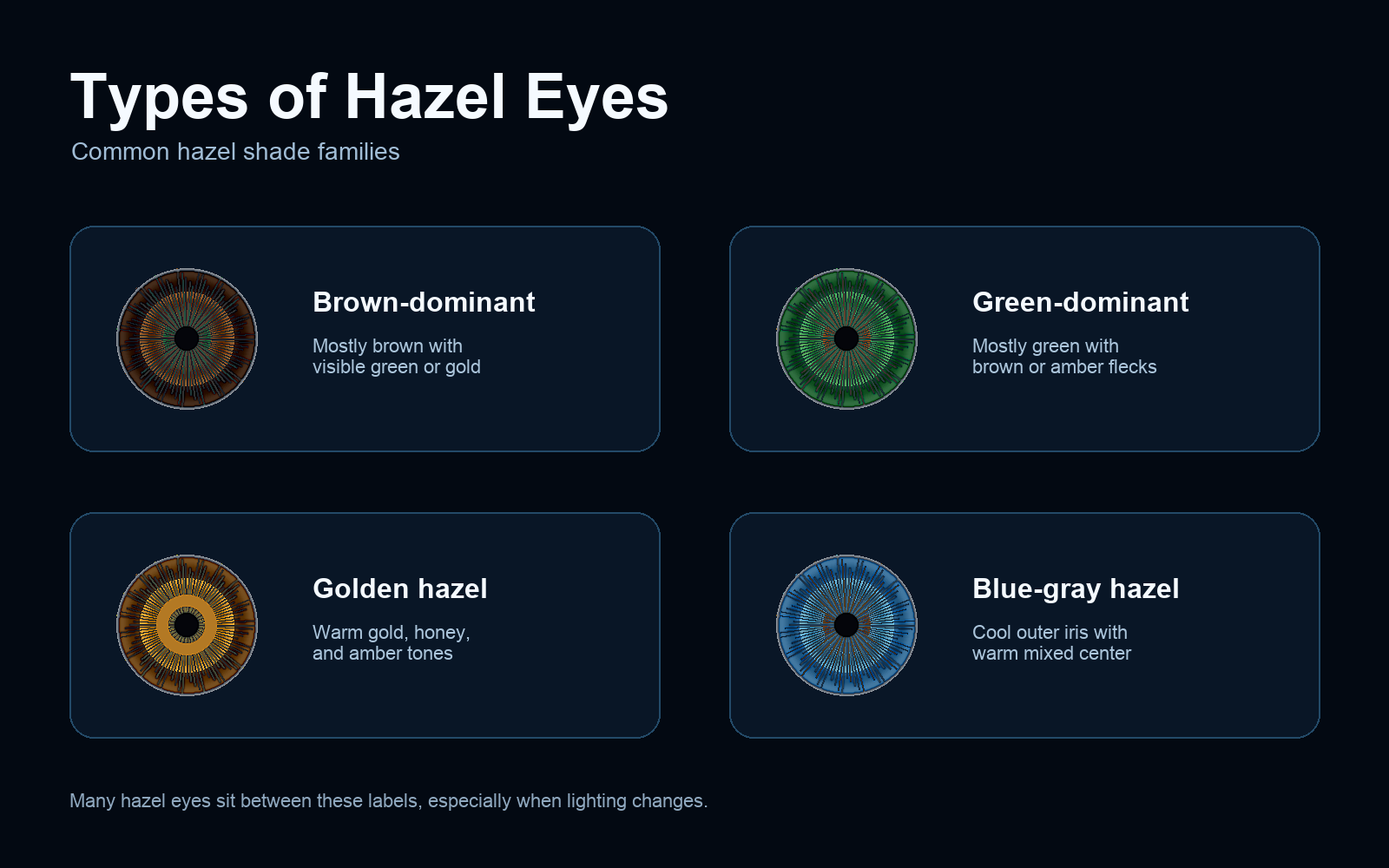
There is no single official hazel eye type chart, but most hazel eyes fall into a few practical shade families. These labels are useful when you are comparing your eye color in photos or using an eye color test.
| Hazel type | What it looks like | Common search |
|---|---|---|
| Brown-dominant hazel | Mostly brown, but green, gold, or amber appears in parts of the iris. | brown hazel eyes |
| Green-dominant hazel | Mostly green, but with brown or amber flecks near the pupil or across the iris. | green hazel eyes |
| Golden hazel | Warm honey, gold, and amber tones, usually with some brown or green mixed in. | gold hazel eyes |
| Blue-gray hazel | A cooler outer iris with warmer brown, gold, or green tones toward the center. | blue hazel eyes |
Hazel vs Green, Brown, and Amber Eyes
The line between hazel and nearby eye colors can be blurry. The best way to tell is to look at the whole iris in indirect daylight and ask whether the color is uniform or mixed.
Why Do Hazel Eyes Change Color?
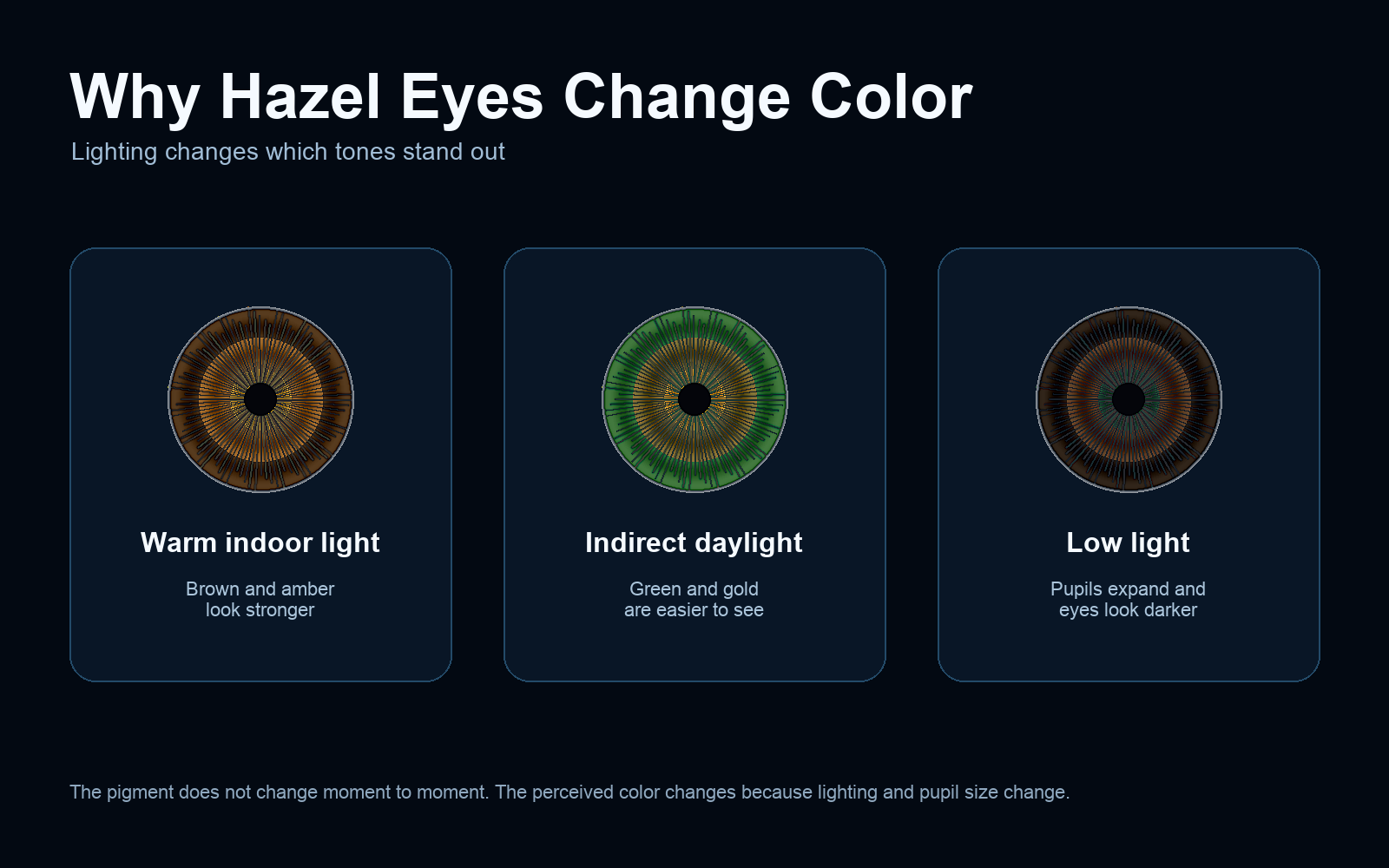
Hazel eyes do not usually change pigment from day to day. They appear to change because lighting, pupil size, clothing, and background colors make different tones in the iris stand out.
In warm indoor light, brown and amber can look stronger. In indirect daylight, green and gold may be easier to see. In low light, the pupil expands and covers more of the iris, often making hazel eyes look darker.
Are Hazel Eyes Rare?
Hazel eyes are uncommon globally, but exact numbers vary by country, ancestry, and how eye colors are classified. Many broad eye color charts place hazel and amber in the smaller percentage groups compared with brown and blue.
Hazel eyes are more common in some populations with European, Middle Eastern, North African, or mixed ancestry. They are less common worldwide than brown eyes, which are the most common eye color overall.
Because hazel is a mixed category, rarity estimates should be treated as rough guides. Some charts group hazel with amber or light brown, while others separate them.
What Causes Hazel Eyes?
Eye color depends mainly on the amount and distribution of melanin in the iris, plus the way light scatters through the iris structure. Brown eyes generally have more melanin, while blue and gray eyes have less visible front-layer pigment.
Hazel eyes usually sit in the middle: enough melanin to create brown and amber tones, but not so much that the whole iris appears uniformly dark brown. Uneven melanin distribution can create green, gold, brown, and amber areas in the same iris.
Eye color inheritance is complex. It is influenced by multiple genes, so it is not as simple as one parent color plus another parent color. That is why siblings can have different eye colors, including hazel appearing in a family where eye colors vary widely.
How to Tell If Your Eyes Are Hazel
Use a close-up eye photo in indirect daylight. Turn off flash, avoid filters, and crop close to the iris. Then look for these signs:
- Brown and green are both visible in the same iris.
- Gold or amber flecks appear near the pupil or across the iris.
- Your eyes look greener in daylight and browner indoors.
- Different people describe your eye color differently.
- The color is mixed rather than one flat shade.
If you still cannot tell, compare your photo with an eye color chart or use an eye color test that can look at the iris more closely.
Related Eye Color Guides
Use these next if you want to compare hazel with nearby colors and mixed patterns.
Find Your Exact Hazel Shade
Hazel eyes can be hard to name because they are mixed. The Eye Color Identifier app analyzes a close-up iris photo and describes your dominant color, secondary tones, and patterns.
Download Free on App StoreFree to download · iOS · No login required
Hazel Eyes FAQ
What color are hazel eyes?
Hazel eyes are a mix of brown, green, gold, and amber tones. The exact balance can be different for every person.
Are hazel eyes green or brown?
They can be both. Hazel eyes usually contain brown and green in the same iris, often with gold or amber tones mixed in.
Are hazel eyes rare?
Hazel eyes are uncommon globally, though exact percentages vary depending on the population and how eye colors are grouped.
Why do hazel eyes look different in different lighting?
Lighting, pupil size, camera exposure, clothing, and nearby colors can make green, brown, gold, or amber tones stand out more strongly.
What is the difference between hazel and central heterochromia?
Hazel eyes usually have blended colors across the iris. Central heterochromia usually has a clearer ring of one color around the pupil with another color outside it.
Can hazel eyes change color permanently?
Subtle eye color shifts can happen with age, but sudden or one-sided eye color changes should be checked by an eye care specialist.