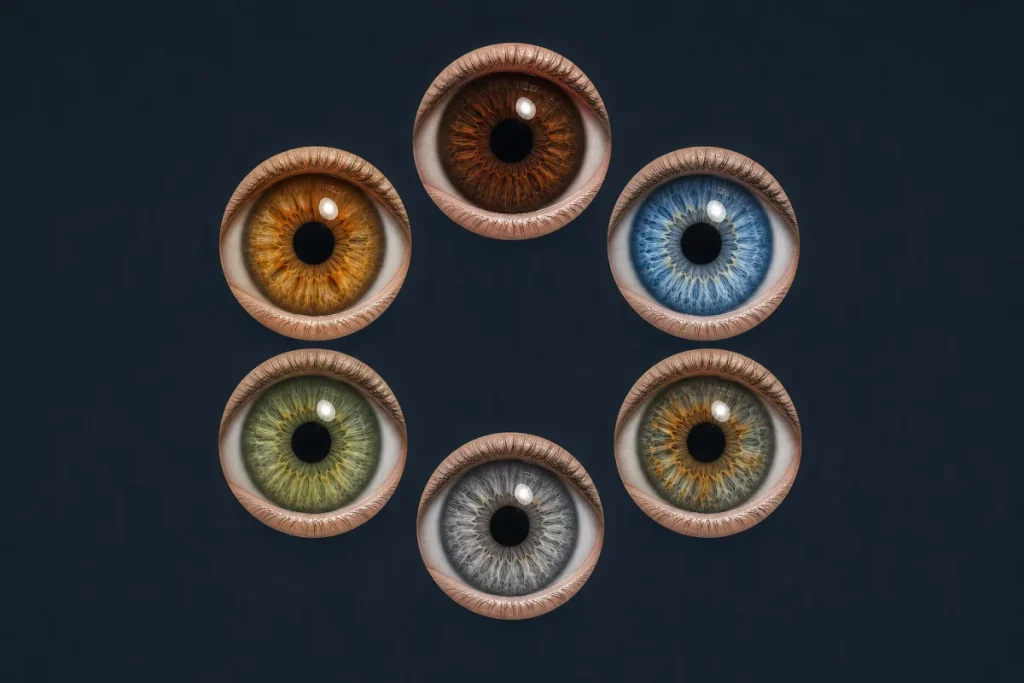
An eye colour chart is most useful when it treats eye colour as a family of shades and patterns, not a single exact label. The commonly named natural families are brown, blue, hazel, green, gray and amber. Many irises also show flecks, rings or blended tones, so a close match may be more helpful than forcing a precise category. Source (accessed 2026-10-20)
Eye colour chart by family
| Colour family | Typical appearance | Often confused with |
|---|---|---|
| Brown | Light honey-brown through deep brown; the iris can look nearly black in low light. | Amber-brown or very dark brown |
| Blue | Clear, cool blue that may range from pale to deep blue. | Gray or blue-gray |
| Hazel | A mixed appearance, often combining brown, green and gold across the iris. | Green, amber or central heterochromia |
| Green | Green or green-gold overall, sometimes with warm flecks. | Hazel or blue-green |
| Gray | A muted, silvery or slate-like look that can appear blue in some conditions. | Blue or blue-gray |
| Amber | A more consistently golden, copper or honey-like appearance. | Light brown or hazel |
These are practical visual labels, not a medical classification system. The iris can contain many shades and patterns within any one of these families. Source (accessed 2026-10-20)
Find the closest match, not a perfect label
Brown and very dark brown
Brown eyes can range from warm, light brown to very dark brown. A dark iris may appear almost black in a photo, but that does not necessarily mean it is a separate colour category. Look for visible warm brown detail in indirect daylight rather than judging from a dim indoor image. For a closer look at the range, see brown eye colour shades and variations.
Blue versus gray
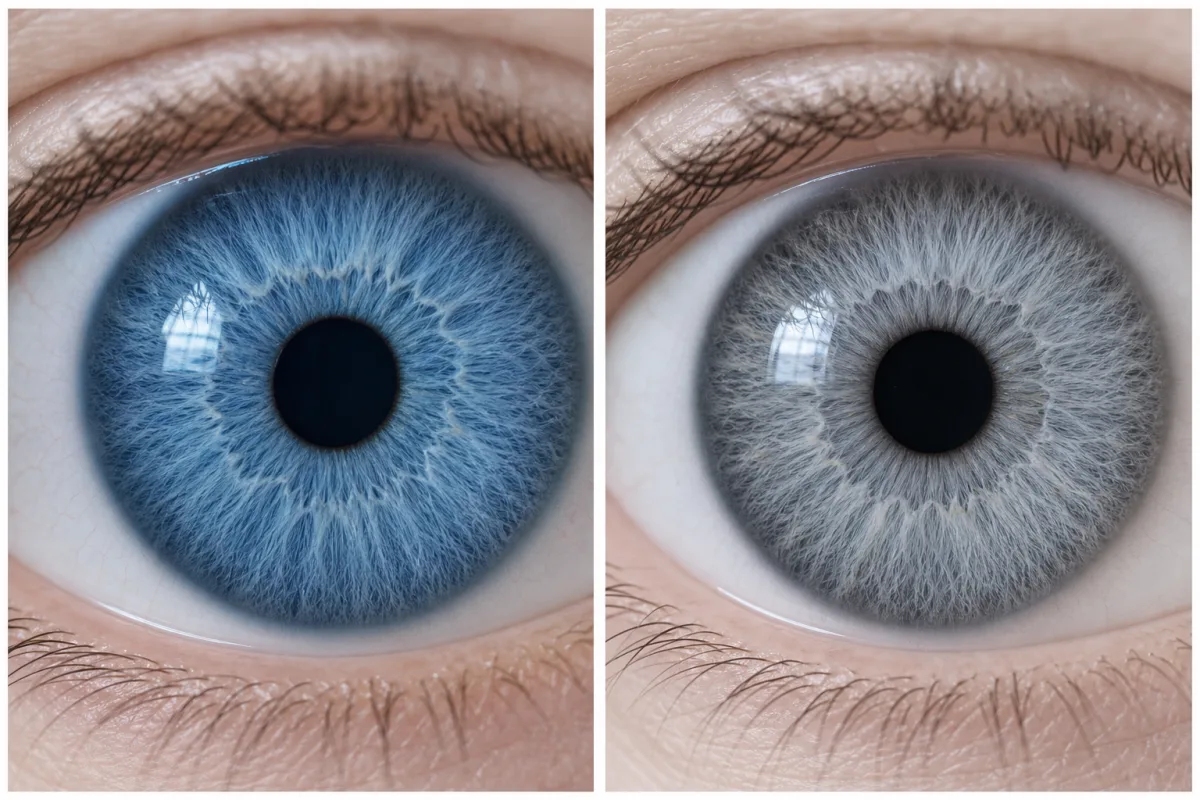
Blue usually reads as clearer and more saturated, while gray tends to look softer, cooler and less saturated. The boundary is not sharp: a gray iris may look blue in bright light, and a blue iris can look gray in shadow. If neither label seems consistently right across well-lit photos, blue-gray may describe the appearance more honestly. Compare blue-gray with blue, gray and hazel.
Green versus hazel
Green eyes often look green across most of the iris. Hazel commonly has a mixed distribution: for example, brown or gold nearer the pupil with greener tones farther out. A scattered blend is different from a distinct inner ring. See green eyes versus hazel eyes for a focused comparison.
Amber versus light brown
Amber is usually used for an iris with a relatively even golden, honey or copper cast. Light brown can share those warm tones but reads predominantly brown. Hazel usually includes a more obvious mixture of green, brown and gold rather than a single warm overall tone. Compare amber and brown eyes.
Use the chart with a better photo
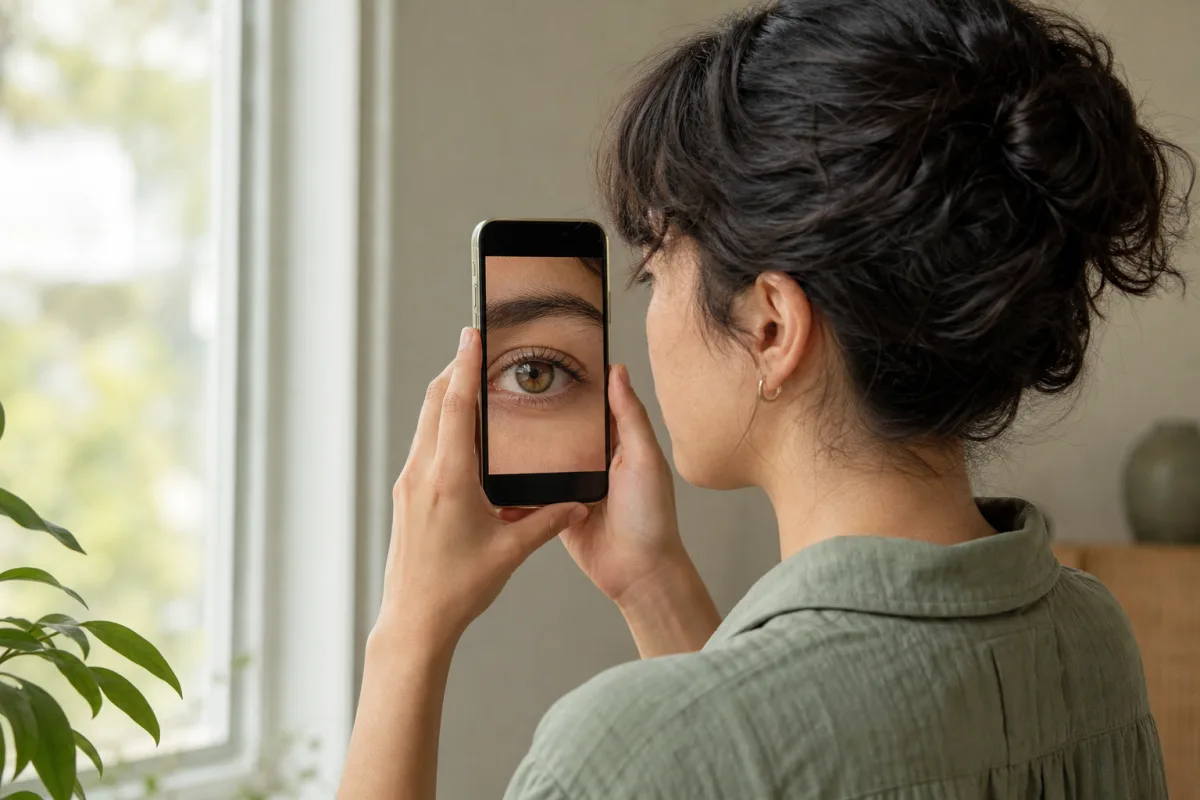
- Stand near a window in indirect daylight. Avoid direct sun, which can create glare and hide iris detail.
- Turn off flash and use a neutral background where possible. Strongly coloured surroundings, clothing and camera processing can change the apparent shade.
- Take several close, in-focus photos that show the iris clearly. Compare them rather than relying on one image.
- Look at the overall iris first, then note secondary features: a darker outer edge, warm flecks, an inner ring or a sector of another shade.
- Choose the family that stays most consistent across the images; keep a mixed-shade description when that is a better fit.
Eye appearance depends on iris pigmentation and on how light is scattered and reflected, which is why a photograph is a useful comparison aid but not an infallible measurement. Source (accessed 2026-10-20)
Why eye colours vary
Melanin in the iris is an important contributor to eye colour. Eye colour inheritance is influenced by multiple genes, so it cannot be reliably predicted with a simple one-gene rule or by treating a parent’s eye colour as a guarantee. Source (accessed 2026-10-20)
In babies, iris colour can appear to change during early development as melanin production changes. That ordinary development is separate from a new or unexpected colour change later in life. Source (accessed 2026-10-20)
More than one colour in one iris
Multiple tones are common. You may notice a darker limbal ring at the outer edge, golden flecks, a warm ring around the pupil, or gradual blending from one shade into another. Hazel is often a useful descriptive label for a blended iris.
Heterochromia describes a difference in iris colour that may affect the two eyes, part of an iris, or an area around the pupil. A clear inner ring of a different colour is often described as central heterochromia; a distinct wedge or patch is often described as sectoral heterochromia. Source (accessed 2026-10-20)
Rarity: use careful language
Brown is widely described as the most common eye colour worldwide, while lighter and less commonly grouped colours can be less frequent in broad populations. A universal ranking for the “rarest” colour is not dependable because studies vary by region and ancestry, use different samples, and group shades differently. Treat rarity labels as broad context, not as a precise fact about an individual iris. Source (accessed 2026-10-20)
When not to rely on a chart
A chart can help you describe a stable appearance; it cannot explain a new eye-colour difference or replace an eye examination. If you notice a new change in colour, a new difference between the eyes, or another eye concern, arrange an assessment with an eye-care professional. Source (accessed 2026-10-20)
Optional photo comparison
If you want a second opinion after using the chart, the Eye Color Identifier Analyzer app is described in its App Store listing as an eye-colour identification tool that uses a photo. Treat any result as a visual suggestion, especially when lighting, focus or reflections are uneven. Source (accessed 2026-10-20)
Eye colour chart questions
What are the main natural eye colours?
Commonly used names are brown, blue, hazel, green, gray and amber. Each is a broad family, and many eyes have mixed shades or visible patterns. Source (accessed 2026-10-20)
Are hazel eyes green or brown?
Hazel is generally a mixed visual description. An iris may show brown, green and gold in different areas, rather than reading as consistently green or consistently brown.
Can my eye colour look different in photos?
Yes. Illumination, reflections, exposure, focus and image processing can change the apparent colour. Compare multiple close photos taken in similar, indirect daylight. Source (accessed 2026-10-20)
Can eyes be two colours?
They can show more than one tone or pattern. Heterochromia is a term used for differences in iris colour that may involve the eyes, a sector of an iris or an inner area around the pupil. Source (accessed 2026-10-20)
Is eye colour inherited from one parent?
No simple one-gene rule accurately explains eye colour. Multiple genes contribute to the trait, so family eye colours are not a reliable prediction formula. Source (accessed 2026-10-20)