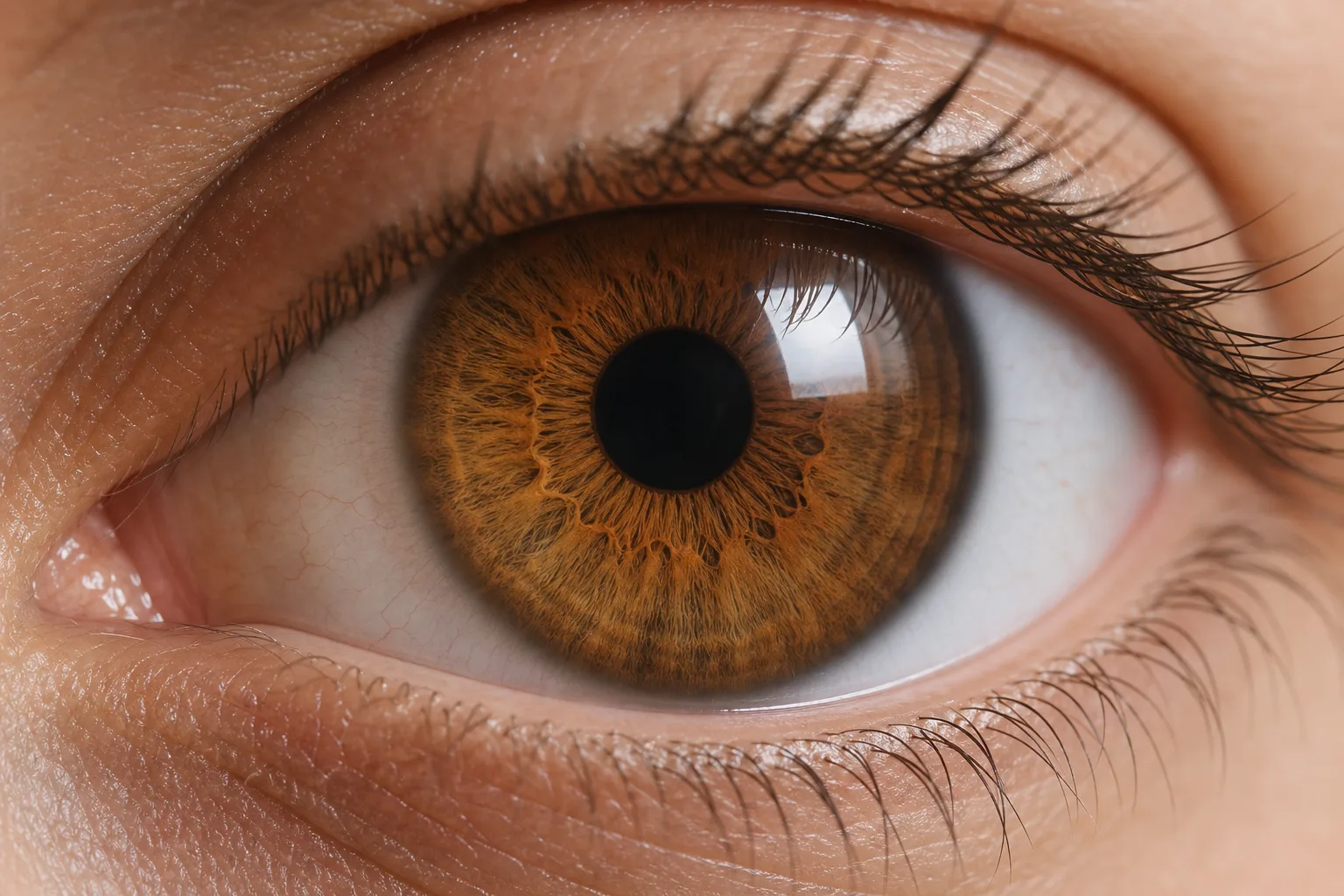
Amber-brown eyes are a useful appearance-based description for irises that read mostly brown but show a clear golden, honey, or copper warmth. They are not a separate medical eye-colour category. The best clue is the iris’s overall colour in neutral daylight: if the warm gold remains visible across much of the iris, “amber-brown” may fit; if it appears only in direct sun or a warm photo, brown is usually the clearer description. Compare amber eye colour.
What amber-brown eyes usually look like
Amber-brown is most helpful when neither simple label feels quite right. The iris may have a medium-to-deep brown base, with a warm cast that looks honey-like, tawny, golden, or coppery rather than neutral chocolate brown. The warmth can be especially noticeable around the pupil, through the middle of the iris, or as a generally golden-brown impression.
Descriptions such as dark amber, warm amber-brown, and golden amber-brown can help someone describe what they see. They are visual terms, not clinical classifications. Iris colour is influenced by the amount and distribution of melanin and by how light interacts with iris tissue; it is not determined by a single pigment test or one simple gene. Source (accessed 2026-08-12)
Amber-brown compared with similar eye colours
| Appearance label | What to look for in neutral daylight | What can cause confusion |
|---|---|---|
| Amber-brown | A brown foundation with persistent gold, honey, or copper warmth. | Warm indoor lighting can make ordinary brown eyes look more amber. |
| Brown | An overall brown iris that may range from light to very dark, often without a broad golden cast. | Sunlight, golden-hour photos, and nearby warm colours can add a temporary amber look. |
| Amber | A more distinctly golden, yellow-gold, or copper appearance across most of the visible iris, rather than merely brown with highlights. | Darker amber can overlap visually with warm brown, particularly in low light. |
| Hazel | A visibly mixed appearance, often combining brown or gold with green and sometimes a changeable-looking outer iris. | A brown iris with a small greenish reflection is not necessarily hazel. |
| Light brown | A lighter brown overall, which may be warm or neutral but does not need a strong amber or copper cast. | “Light” describes brightness; “amber” describes a golden-to-copper quality. |
A practical distinction is uniformity. Amber often looks broadly golden or coppery through much of the iris. Amber-brown retains a brown overall impression but has a noticeable warm-gold character. Hazel more often looks genuinely mixed, with green present as part of the iris pattern rather than as a brief reflection. Eye-colour labels are descriptive and naturally overlap at their edges. A comparison with hazel eye colour patterns can make the green-versus-gold distinction easier to see.
Popular explanations sometimes reduce amber and brown to a simple contrast between named pigments. That shortcut is incomplete. Current genetics references describe eye colour as a complex trait involving multiple genes, melanin, and iris structure. It can explain why broad colour families overlap in photographs, but it cannot identify a person’s eye colour from a pigment claim alone. Source (accessed 2026-08-12)
Why brown eyes can look amber in sunlight
Yes, brown eyes can look amber in sunlight or warm surroundings. Light entering and reflecting around the iris can make golden undertones more noticeable. A warm lamp, a sunset-toned wall, gold clothing, colour grading, and automatic camera white balance can all push a photo toward yellow or copper. This is a change in appearance, not proof that the iris itself has changed colour.
Some amber-eye explainers also note that amber can look more golden in bright light and more brown in dim conditions. That is a useful observation, but it is not a reliable test by itself: the same lighting effect can happen with warm brown eyes. Source (accessed 2026-08-12)
Pupil size adds another source of confusion. In dim light, the pupil is larger and less iris is visible; in brighter light, more of the iris is visible and fine gold or copper details may stand out. Do not decide from a single close-up taken with flash, a beauty filter, or strong sunlight.
A better self-check for amber, brown, or a blend
- Use indirect daylight near a window, rather than direct sun, coloured LEDs, or a warm bathroom bulb.
- Take an unfiltered photo with the camera flash off. If possible, compare it with what you see in a mirror under the same light.
- Look at the overall iris first, not only the ring around the pupil or a bright highlight.
- Ask whether gold or copper remains visible when the light is neutral. If it disappears outside warm light, describe the eyes as brown with warm undertones.
- Check for real green areas before calling an iris hazel. A tiny green reflection, especially near an edge, is not the same as a mixed green-and-brown iris.
- Keep the label proportionate to what is visible. “Warm brown” can be more accurate than forcing a rare-sounding category.
A photo-based result can be a useful description of visible colour, but it is not a clinical assessment. Comparing more than one unfiltered image is generally more informative than relying on a single dramatic picture. For broader visual comparisons, see brown, blue, and green eye differences and the site’s eye colour guides.
Are amber-brown eyes rare?
There is no dependable percentage for “amber-brown eyes.” The label is not consistently defined in population research: one person may call a warm brown iris amber-brown, while another may call the same iris brown or dark amber. That makes a precise prevalence claim misleading.
Brown is widely described as a common eye-colour family, while amber is commonly described as uncommon. But rarity estimates for amber vary with the definition used, the population studied, and whether observers separate amber from hazel and light brown. It is more accurate to say that distinctly amber-looking irises are less often reported than brown irises than to assign an exact percentage to amber-brown. Source (accessed 2026-08-12)
Amber can occur naturally. It is an ordinary variation in visible iris appearance, not evidence of a special personality trait, ancestry result, or health status. Genetics and iris pigmentation are complex, so appearance alone cannot establish a person’s genetic background. Source (accessed 2026-08-12)
Can brown eyes become amber?
Brown eyes can appear more amber under different lighting, in different photographs, or as the pupil changes size. That short-term shift is distinct from a stable iris-colour change. Eye colour can also change gradually during early life, and genetics references note that eye colour is shaped by melanin-related development and multiple genes. Source (accessed 2026-08-12)
If a new or marked change in one eye’s appearance concerns you, or follows an injury, medication change, pain, redness, or vision symptoms, do not use an online colour label as an explanation. Arrange an assessment with an eye-care professional. This page is for appearance-based description, not diagnosis.
Quick answer: which label is closest?
- Choose brown when the iris looks brown in neutral daylight and gold appears mainly with warm light.
- Choose amber-brown when brown is still the base colour but honey, gold, or copper remains clearly visible in neutral light.
- Choose amber when a golden or coppery impression dominates most of the iris rather than appearing as a brown undertone.
- Choose hazel when brown or gold is visibly combined with green across meaningful areas of the iris.
If your eyes sit between labels, that is normal. “Amber-brown” is a clear, honest description for a warm brown iris with lasting golden character; it does not need to be treated as a separate biological category. You can also explore unusual eye-colour comparisons for more context on overlapping shades.
Why do photos disagree about my eye colour?
Different cameras and lighting systems interpret colour differently. White-balance adjustments can make an image cooler or warmer, while exposure can lighten dark brown irises and reveal golden detail. Compare photos taken in neutral daylight without filters before drawing a conclusion.
Are dark amber eyes the same as amber-brown eyes?
They can describe a similar look. “Dark amber” places more emphasis on the amber quality, while “amber-brown” acknowledges that the iris reads as brown overall. Use the wording that best matches its appearance in neutral daylight.