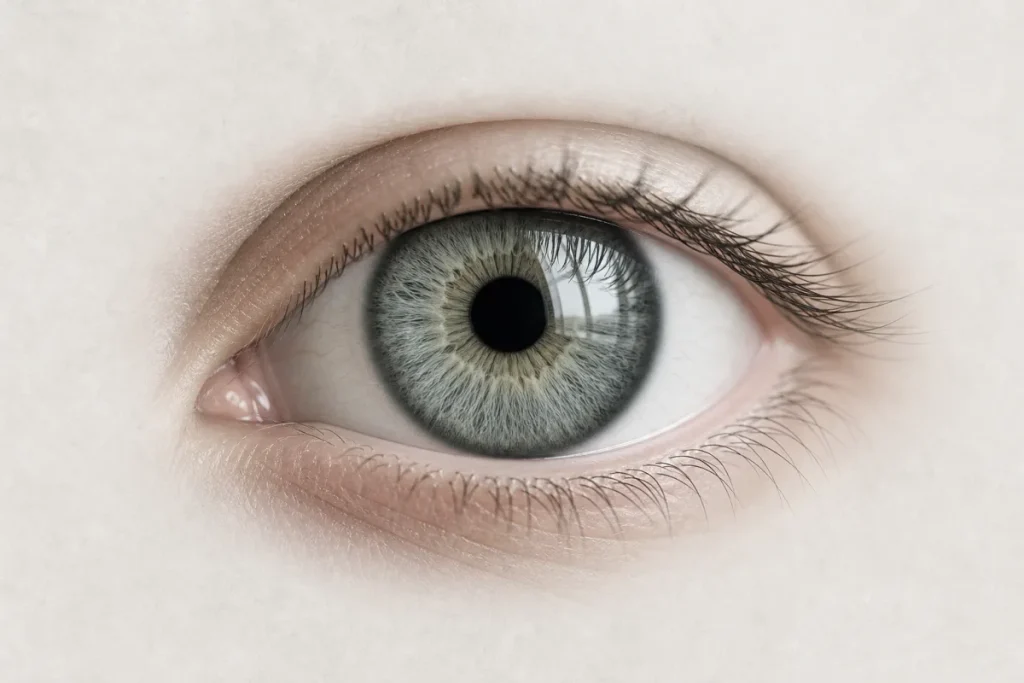
Grey-green eyes usually look like a cool, soft grey iris with a noticeable green cast, often most visible around the outer iris or in muted flecks. It is a useful descriptive label, not a diagnosis or a universally fixed category: one person may call the same iris grey-green while another sees grey, green, or blue-grey.
The most reliable way to describe the blend is to look for its dominant overall tone before focusing on small flecks. If the iris reads as silvery or slate-like from a normal viewing distance, then reveals moss, sage, sea-green, or olive notes in neutral light, “grey-green” is often a fair description. If warm gold, amber, or brown is a strong part of the pattern—especially near the pupil—hazel may be a more useful label.
What grey-green eyes tend to look like
Grey-green irises often have a low-saturation, cool appearance rather than a bright leaf-green look. The green may be diffuse across the iris, collected near the edge, or present as subtle radial streaks. A darker limbal ring can make the iris seem greyer; warm central tones can make it appear more hazel-like.
-
Grey base: slate, silver, smoke, stone, or blue-grey is the first impression.
-
Green influence: muted sage, moss, olive-green, or cool sea-green appears across or within the grey.
-
Low warmth: little obvious amber or brown is visible at a normal distance.
-
Variable appearance: the balance between grey and green can look different across photographs or lighting conditions.
Human eye colour is influenced by melanin in the iris and by how light interacts with iris structures. It is genetically complex rather than controlled by one simple eye-colour gene. Source (accessed 2026-10-23)
Grey-green eyes compared with similar colours
| Colour description | What usually stands out | What can make it easy to confuse |
|---|---|---|
| Grey-green | A cool grey overall impression with subdued green visible in the iris. | Shade can make the green difficult to see. |
| Grey | Silver, charcoal, slate, or blue-grey dominates, with little clear green. | Cool lighting can mute green that is present. |
| Green | Green is the dominant read across most of the iris. | Desaturated green can look grey from a distance. |
| Blue | A clearer blue or blue-grey cast dominates over green. | Reflections from foliage or clothing may add an apparent green tint. |
| Hazel | Green commonly appears alongside more visible gold, amber, or brown tones. | A cool, low-warmth hazel iris may be called grey-green by some observers. |
For a closer green-versus-hazel comparison, see Green Eyes vs Hazel Eyes: What Sets Them Apart. If blue is the main alternative you are considering, Blue Green Eye Color: How to Tell the Shade, Blend, and Pattern can help separate a blue-led blend from a grey-led one.
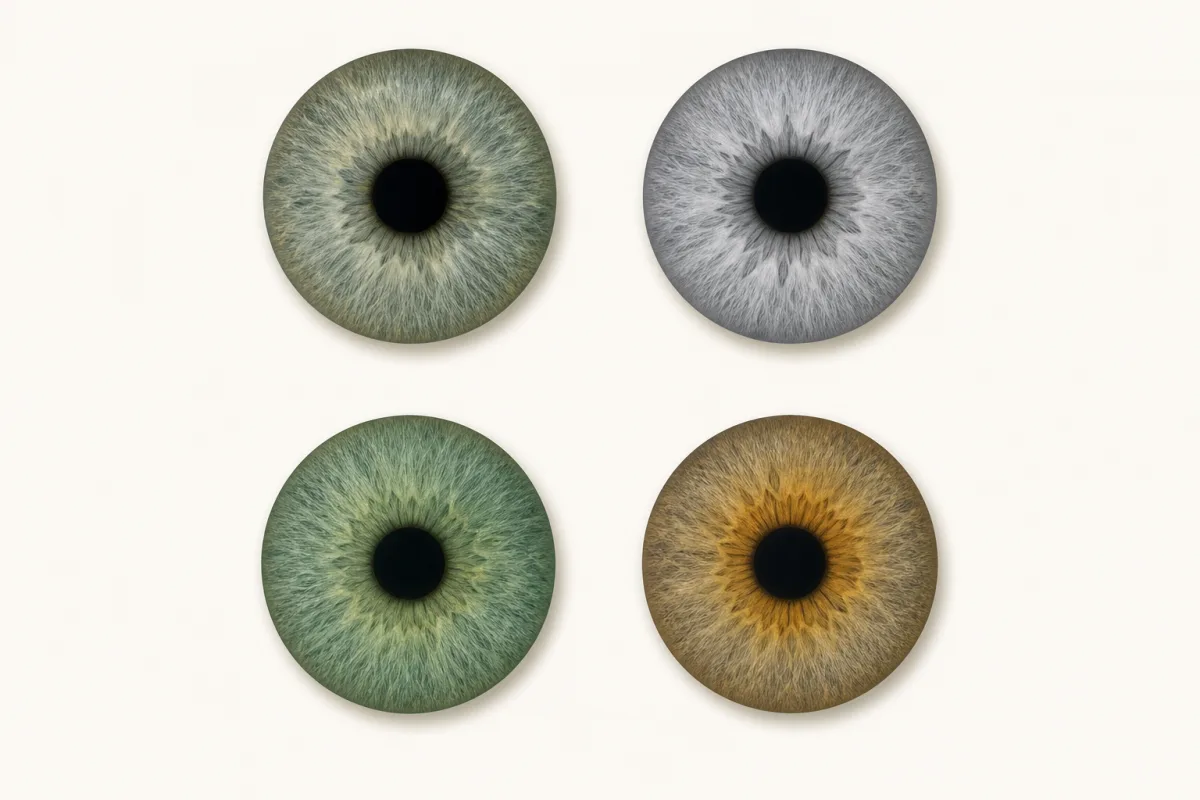
How to identify your dominant tones from a photo
-
Use a sharp photo taken in soft daylight near a window. Avoid coloured LEDs, beauty filters, strong flash, and heavily edited images.
-
Look at the iris as a whole before zooming in. Ask whether its broadest visual field looks cooler grey, greener, bluer, or warmer hazel.
-
Check the area around the pupil separately. A concentrated warm gold or brown ring can change the most helpful everyday label from grey-green to hazel.
-
Look toward the outer iris for a cool grey or blue-grey field. Small green flecks alone do not necessarily make the whole iris green.
-
Compare more than one neutral-light image. Keep the description that remains most consistent, while accepting that a blended iris need not fit one neat label.
Try the site’s eye colour identifier if you would like a photo-based starting point. The associated app is described as an eye-colour identifier and analyzer; treat any result as a descriptive aid and compare it with the iris pattern you can see. Source (accessed 2026-10-23)
Why the same eyes can look greyer or greener
An iris does not need to change its pigment for its apparent colour to shift. Daylight direction, a dark room, a bright sky, nearby green scenery, makeup, clothing, camera white balance, and exposure can all change the colour contrast reaching your eyes or camera. Pupil size also changes how much of the iris is visible, which can alter the impression of its pattern.
That is why one unfiltered photograph may look grey-blue and another may look distinctly green. Eye-colour appearance depends on iris pigmentation and the scattering and reflection of light, so a photograph is not a colour-standard test. Source (accessed 2026-10-23)
A practical check is to compare photos taken in similar indirect daylight, with a neutral background and no colour filter. This reduces avoidable differences, but it cannot turn a variable-looking iris into a single objectively perfect label.
Are grey-green eyes rare?
It is reasonable to call grey-green eyes uncommon, but a precise worldwide rarity figure is not dependable. Surveys may combine grey-green with grey, green, blue-green, or hazel; they may also use different self-reported categories and draw from different populations. For that reason, a single global percentage can give a false sense of precision.
Eye-colour inheritance is complex, involving variation in multiple genes related to pigment production, storage, and distribution. Broad ancestry and population history can influence which iris colours are more frequently observed, but they cannot reliably predict one individual’s eye colour from family background alone. Source (accessed 2026-10-23)
Colours and makeup that can emphasize the blend
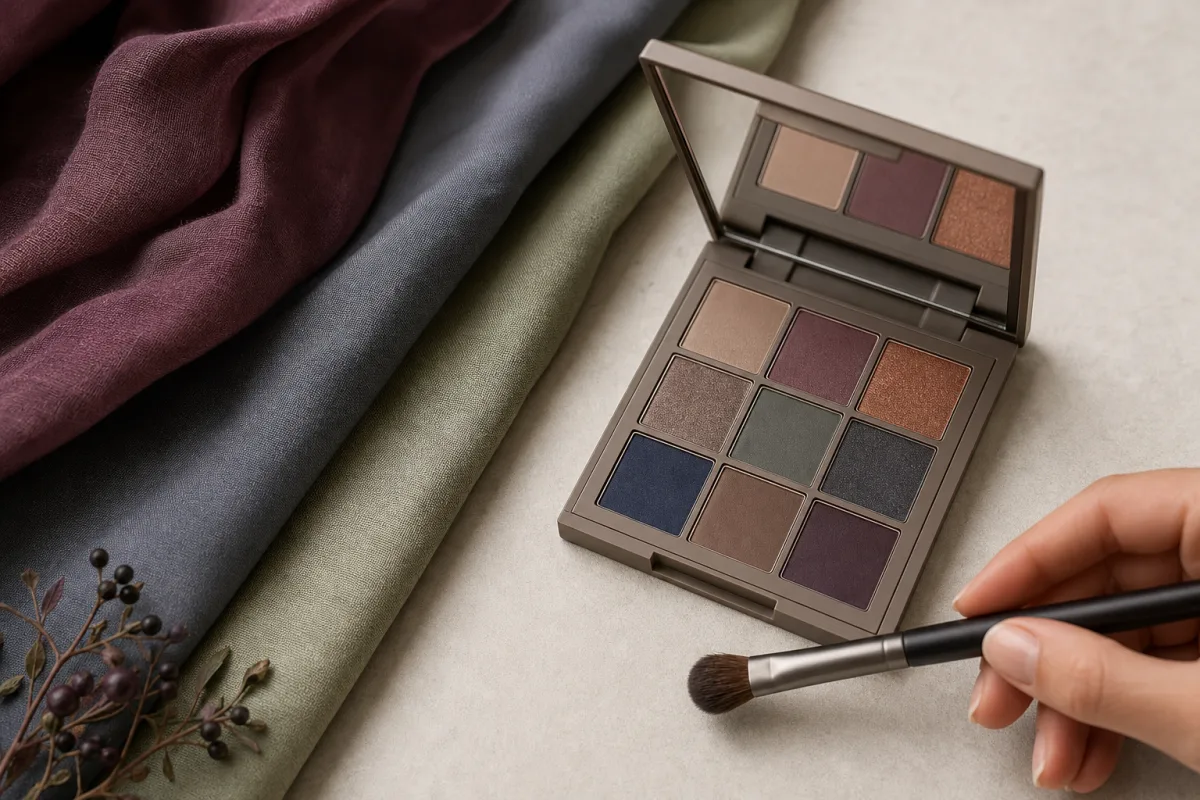
Styling cannot alter iris pigment, but surrounding colour can emphasize a tone that is already present. For a greener impression, try muted plum, aubergine, berry, rose, copper, terracotta, or warm taupe near the eyes. For a cooler, greyer impression, charcoal, pewter, soft navy, cool mauve, slate, and silver-grey can work well.
These are visual preferences, not rules. A soft wash of one shade is often more revealing than a highly contrasting look, because very intense colour can compete with the subtle iris tones you are trying to notice.
When colour variation deserves an eye-care conversation
Ordinary differences between lighting conditions or photographs are common. A new, persistent change in one eye, a newly different-looking iris, or a colour change accompanied by pain, redness, light sensitivity, injury, or vision symptoms is different from ordinary appearance variation. Arrange an assessment with an eye-care professional rather than trying to classify the change from a photo. Heterochromia and changes in iris appearance can have different causes, so personal evaluation matters. Source (accessed 2026-10-23)
Common questions about grey-green eyes
What are grey-green eyes called?
“Grey-green” is usually the clearest everyday term when neither grey nor green alone captures the dominant appearance. “Green-grey” and “grey hazel” may also be used, depending on whether green or warm central tones are more noticeable.
Are grey-green eyes attractive?
Attractiveness is personal and culturally shaped, not a property that can be measured from an eye-colour label. Grey-green eyes often draw attention because their muted blend can look different in different settings.
Are grey-green eyes gender-specific?
No. Eye-colour descriptions such as grey-green are not gender-specific.
Is grey-green the same as hazel?
Not necessarily. Hazel usually has a more apparent mix of green with gold, amber, or brown. A predominantly cool iris with little warmth is more likely to be described as grey-green. Compare it with Hazel Eyes: Color, Rarity, Meaning & Examples and Gray Eyes: A Closer Look at the Rarest Base Color.