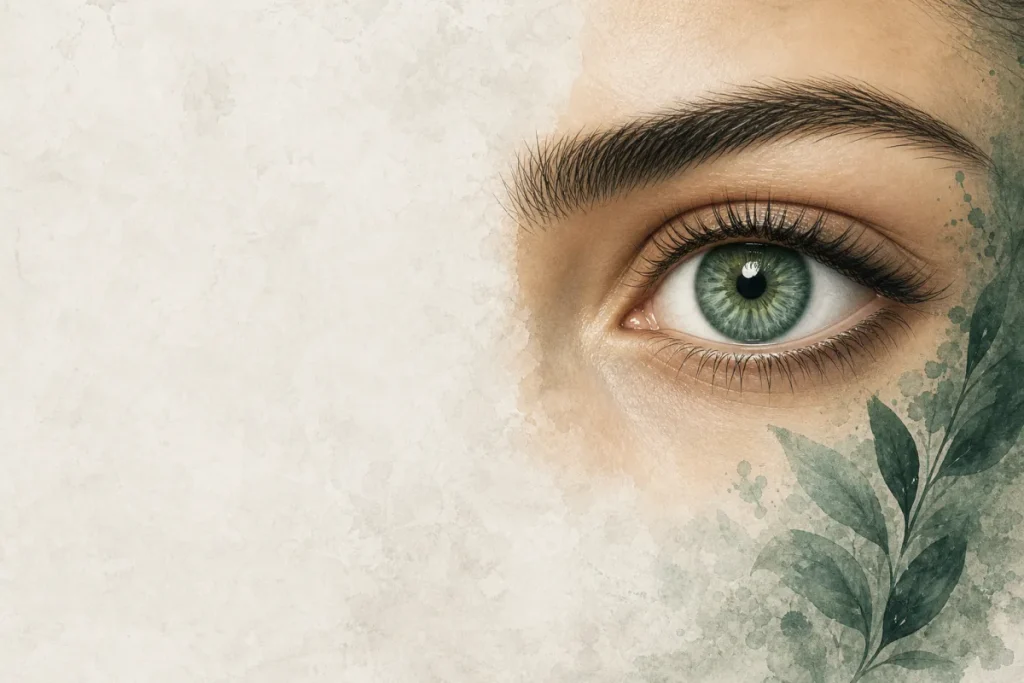
Emerald green eye colour is a descriptive label for an iris that looks distinctly green, relatively vivid, and often cool or jewel-toned rather than yellow-brown. It is not a medical eye-colour category with a fixed boundary. The most useful way to identify it is to compare several clear photos taken in neutral, even light and look for a green iris colour that remains the dominant impression.
What “emerald green” describes
In everyday use, “emerald” usually suggests a clear green with noticeable saturation. An emerald-looking iris may have darker radial lines, a darker limbal ring, or small gold flecks; those features do not automatically make the overall eye colour hazel. What matters is the broad colour seen across most of the iris, not a tiny ring near the pupil or a single reflected highlight.
Natural eye colour is influenced by the amount and distribution of melanin in the iris and by how light is scattered through iris tissue. Green eyes are not created by green pigment alone; the visual result comes from these interacting optical and pigment factors. Source (accessed 2026-11-03)
“Emerald” is therefore best treated as a useful visual description, not as a genetic result or a diagnosis. If an eye looks green in balanced light but shifts between cooler and warmer greens in different settings, that can still fit an emerald-green appearance.
Why the shade can look different
An iris can appear more vivid outdoors, deeper in shade, or more yellow-green beside warm colours without its underlying eye colour having changed. Illumination, reflections, camera processing, white balance, and the colours around the face all affect the colour signal reaching the eye or camera. Human colour perception also depends on context and adaptation to surrounding light. Source (accessed 2026-11-03)
For a more dependable comparison, use indirect daylight near a window, face the light, remove coloured makeup or tinted glasses, and avoid flash. Take more than one image with the same camera setting. A close crop can help, but keep enough of the sclera visible to judge whether the image has a strong colour cast.
Try not to assign a shade from one dramatic sunlit photo. Direct sun can brighten iris texture and create reflections that make almost any green eye look more jewel-like. Indoor photos under warm lamps can do the opposite, pulling a green iris toward olive or brown.
For another mixed-colour example, see Blue Green Eye Color: How to Tell the Shade, Blend, and Pattern. For a broader side-by-side reference, use the Eye Colour Chart: Compare Natural Shades.
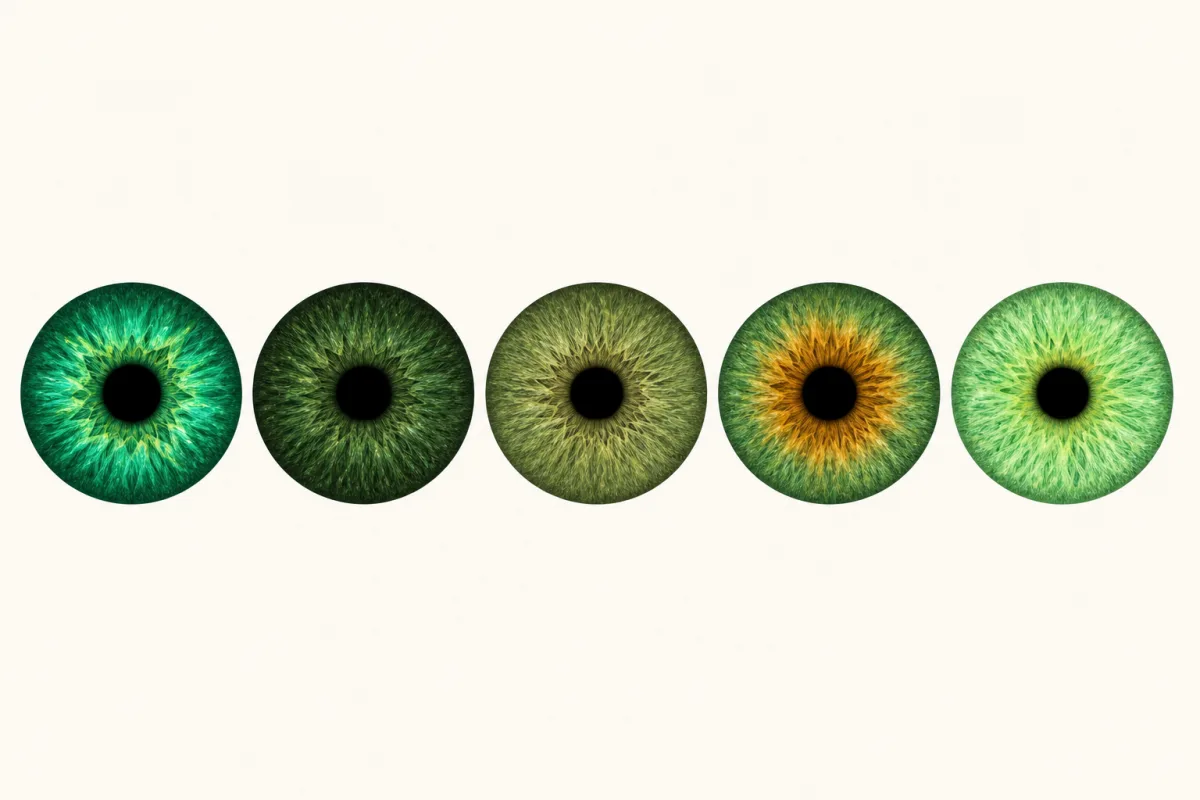
Compare emerald with nearby green and hazel shades
These labels overlap, and no single photo can settle every borderline case. This comparison works best as a practical vocabulary for describing what you see.
| Appearance label | Typical overall impression | What to check |
|---|---|---|
| Emerald green | Clear, fairly vivid green; often cool or balanced rather than strongly yellow. | Green remains dominant across most of the iris in neutral light. |
| Forest green | Deep, dark green with lower apparent brightness. | Look for a green base that stays dark even when the photo is well lit. |
| Olive green | Muted green with a yellow, khaki, or earthy cast. | Warm yellow-green is visible broadly, not only around the pupil. |
| Hazel-green | Green visibly mixed with brown, gold, or amber, often in a central pattern. | Check whether warm brown or amber occupies a substantial part of the iris. |
| Bright green | Light or high-contrast green that may look especially luminous. | Separate true iris colour from bright reflections or an overexposed image. |
A concentrated golden ring around the pupil can occur in an eye that otherwise reads green. By contrast, when brown, amber, or gold forms a broad and consistent component of the iris, “hazel-green” may be the clearer description. Our comparison of green eyes and hazel eyes explains that distinction in more detail.
Natural colour, lenses, and edited images
Coloured contact lenses, beauty filters, selective colour edits, and dramatic lighting can all create an emerald effect in a photograph. A photo can be attractive without being reliable evidence of a person’s natural iris colour. When comparing images, look for consistent colour across unfiltered photos taken in different neutral settings.
Decorative contact lenses are medical devices in the United States and should be obtained with an eye-care prescription and fitted appropriately; sharing lenses or using them without proper care can raise the risk of eye injury and infection. Source (accessed 2026-11-03)
A photo-based eye-colour identifier can provide a starting label, but it is interpreting the pixels in that particular image. Treat the result as a comparison aid, then check it against photos in more than one lighting condition. Explore related shade descriptions in Green Eye Color: Why So Few People Have It.
Meaning, health, and common questions
Emerald green eyes do not have an established personality meaning. Ideas linking eye colour to character, luck, or destiny are cultural associations, not a way to infer someone’s traits or health.
Natural iris colour is generally stable after early childhood, although its apparent shade can vary with lighting and context. A noticeable new change in one or both eyes, especially with pain, redness, light sensitivity, blurred vision, or new floaters, is a reason to seek timely advice from an eye-care professional. Those symptoms can occur with eye conditions that need assessment. Source (accessed 2026-11-03)
Are emerald green eyes naturally occurring?
Yes. “Emerald” is a descriptive way of naming a naturally green-looking iris; it is not a separate medical category or proof of a particular genetic pattern.
Are emerald green eyes the rarest green shade?
There is no standardized global system that counts emerald, forest, olive, and bright green as separate categories. Claims that one named green shade is definitively the rarest should be treated cautiously because labels and classification methods differ.
Are emerald green eyes more common in men or women?
There is no sound basis for identifying an individual’s sex or gender from an emerald-looking eye colour. Eye-colour labels are not a reliable demographic marker.
If your eyes sit between labels, that is normal: “green,” “emerald,” “olive,” and “hazel-green” are descriptive tools, not tests. Choose the term that reflects the dominant iris colour under balanced light, and leave room for mixed patterns.