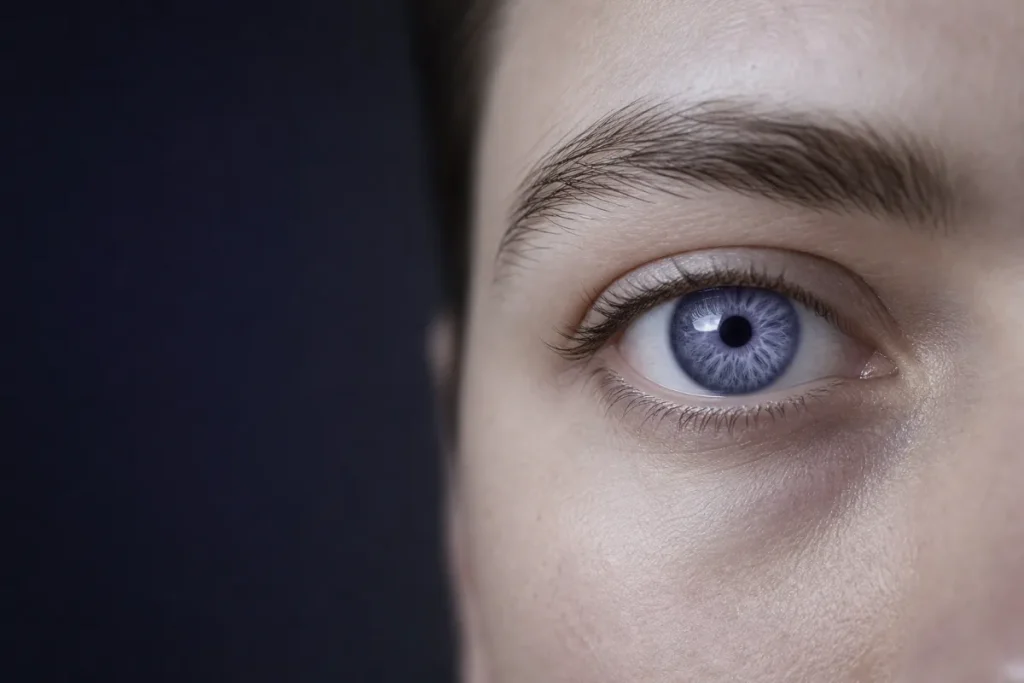
Violet-coloured eyes can be a real appearance, but “violet” is usually a visual description rather than a separate, fixed iris-colour category. A very lightly pigmented iris may look blue-violet or grey-violet in some conditions. In people with albinism, low pigment can also make the eye appear red, pink, or violet under certain lighting. There is no well-supported worldwide percentage for naturally violet-looking eyes. Source (accessed 2026-11-24) Source (accessed 2026-11-24)
What people usually mean by violet-coloured eyes
Most descriptions of violet eyes refer to an iris that reads as cool blue with a purple cast, or pale grey with a lavender cast. It may look more violet near the outer iris, while the area around the pupil still looks blue, grey, or light brown. A single label can miss that variation.
Eye colour relates to the amount and distribution of melanin in the iris. Blue eyes do not contain blue pigment. Their appearance is linked to how light is scattered through an iris with relatively little melanin. That is one reason the same iris can look bluer, greyer, or more violet in different photographs and surroundings. Source (accessed 2026-11-24)
“Purple” and “violet” are often used as synonyms in everyday speech. For careful identification, blue-violet or grey-violet is usually more useful when blue or grey remains the dominant impression in neutral light.
Why an iris can look violet
A violet cast is most plausible when a light iris has little visible yellow or brown warmth. Daylight, a cool white screen, reflected colour from nearby clothing, eye makeup, camera white balance, and image editing can each shift the apparent shade. That does not mean the person’s natural iris has changed.
Look at several ordinary, unfiltered photos taken in different light before settling on a label. A close photo taken under a coloured lamp is a poor basis for naming a natural eye colour. So is a photo with a strong filter, very small iris area, or a bright catchlight covering the iris texture.
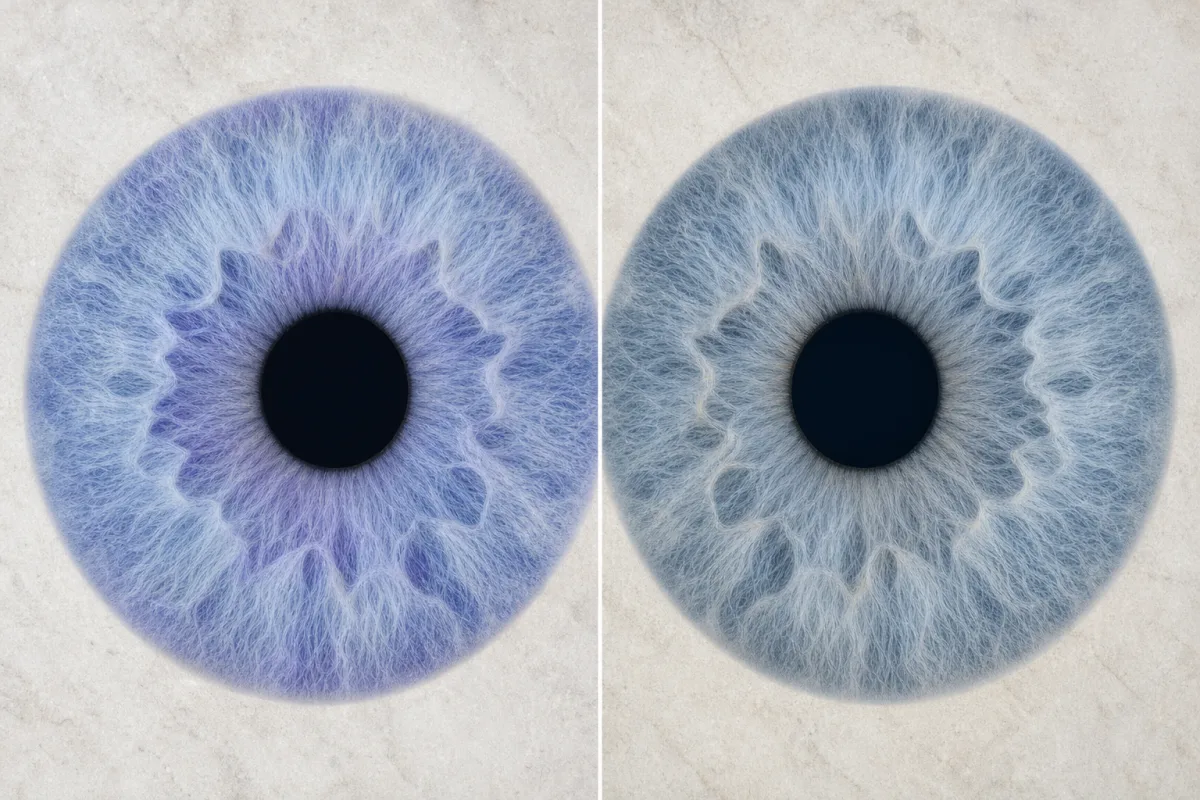
Violet-looking eyes and albinism need different care
Albinism is a group of inherited conditions involving reduced melanin production. Oculocutaneous albinism can affect pigmentation in the eyes, skin, and hair, and it can be associated with vision differences. Reduced iris pigment can allow more light-related effects to be visible, which helps explain why eyes may be described as red, pink, or violet in some images. Source (accessed 2026-11-24)
An eye photo cannot diagnose albinism, rule it out, or predict a person’s genetics. The responsible description is simply what is visible: for example, “a pale iris with a violet appearance in this lighting.”
Tell violet from blue, grey, hazel, and red-looking eyes
| Appearance | What to look for in neutral daylight |
|---|---|
| Blue-violet | A clearly blue base with a cool purple cast and little yellow warmth. |
| Grey-violet | A low-saturation, silvery base that shifts lavender in some light. |
| Hazel | Visible brown, gold, or green variation, often strongest around the pupil. |
| Red-looking | A photographic or lighting appearance that should not be treated as an iris-colour diagnosis. |
If you are torn between blue and violet, start with blue as the base colour and add “violet-looking” only if the purple cast remains across several neutral-light photos. Compare the warm and cool tones with brown, blue, and green eye differences, then look at the quieter end of the spectrum in this guide to grey eyes. A green-and-gold mix points in a different direction from violet, as explained in green versus hazel eyes.
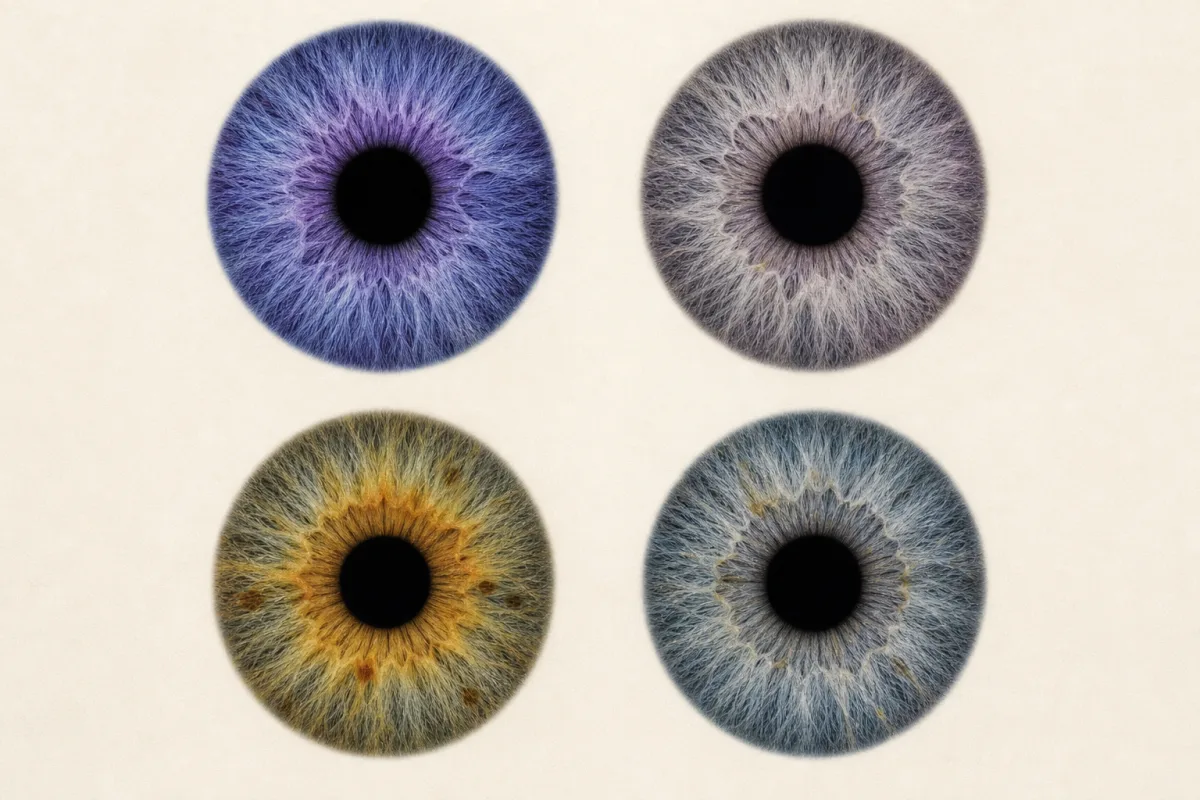
A photo can show an appearance, not settle a lifelong colour
Say you have a selfie where your eyes look lavender, but a window-light photo makes them look soft blue-grey. Start with the window-light image. Check whether the iris still has a purple cast away from bright reflections and makeup shadows. If it does, “blue-violet” or “grey-violet” is a fair appearance label. If the cast disappears, blue-grey is the more dependable description.
Photo-based identification can be a useful starting point when you want a consistent label for what is visible. The eye colour identifier is described as identifying eye colour from a photo. Treat any result as a description of that particular image, especially when light, lenses, or edits may be involved. Source (accessed 2026-11-24)
Ways to judge a violet appearance, with their limits
Neutral-light comparison: Use a plain window-light photo and compare the iris with nearby blue and grey examples. This is the best everyday option because it reduces dramatic colour casts. It still depends on the camera.
Several unfiltered photos: Compare images made on different days and in different neutral settings. This suits someone who wants to know whether violet is consistent. It takes more patience, but it is better than trusting a single striking portrait.
A photo identifier: This is quick and useful for a first visual label. It suits curiosity and sorting photos. It cannot establish natural colour, diagnose an eye condition, or override what remains visible across better images.
Coloured contact lenses: These can deliberately create a violet look. They are a style choice, not evidence of natural iris colour. For a natural-colour description, assess the eye without cosmetic lenses.
I would pick neutral-light comparison first, then use several ordinary photos if the result is still unclear. It is slower than trusting one vivid image, but it gives the colour less room to be invented by the scene.
Elizabeth Taylor and the violet-eye story
Elizabeth Taylor is often described as having violet eyes. Publicity photographs, film lighting, makeup, colour processing, and repeated celebrity retellings make that claim hard to verify as a stable natural-colour label. The useful takeaway is narrower: a memorable violet appearance in an image does not prove that violet was the iris’s fixed colour in ordinary neutral light.
Rarity claims need a little restraint
Violet is commonly placed among rare eye-colour descriptions, but a reliable worldwide share is not established. The reason is practical as well as scientific: studies commonly group eye colours into broader categories, while “violet” is often an observer’s description of a blue, grey, or low-pigment appearance. Treat precise viral rarity figures with caution unless they identify a sound population study and a clear definition of violet.
For a comparison with a warmer uncommon-looking shade, see how amber eyes are identified. Amber’s gold or copper warmth is usually easier to separate from violet than blue-grey is.
If your eye colour seems to have changed
A difference between photos often comes from lighting or camera processing. A new change you can see in the mirror, especially when it comes with pain, redness, blurred vision, light sensitivity, or an injured eye, deserves prompt advice from an eye-care professional. Do not rely on a photo label to explain a health concern.
What I would do if I were trying to name this shade today
I would take a fresh, unfiltered photo by a window with no coloured light nearby. I would check the iris in more than one ordinary image and decide on the base colour first: blue, grey, hazel, or brown. Only then would I add violet-looking if that cool purple cast keeps showing up. I would leave celebrity comparisons, rarity rankings, and dramatic filtered photos for later. They are interesting, but they are weak evidence for your own eyes.
Questions people ask about violet-looking eyes
Are violet eyes naturally possible?
A violet-looking appearance is possible, particularly as a blue-violet or grey-violet appearance in a lightly pigmented iris. In the context of albinism, low pigment can also contribute to red, pink, or violet descriptions under some conditions. Source (accessed 2026-11-24) Source (accessed 2026-11-24)
Are violet eyes the same as purple eyes?
In ordinary conversation, the terms often mean the same thing. For identifying an eye in a photo, blue-violet or grey-violet gives a clearer account of the visible base colour.
Can contact lenses make eyes look violet?
Yes. Cosmetic coloured lenses can create a violet appearance, so they should be removed before trying to describe natural iris colour.
Is there a dependable percentage for violet-coloured eyes?
No accepted worldwide percentage is available for violet-looking eyes. Broad eye-colour categories and changing visual descriptions make a precise figure unreliable.