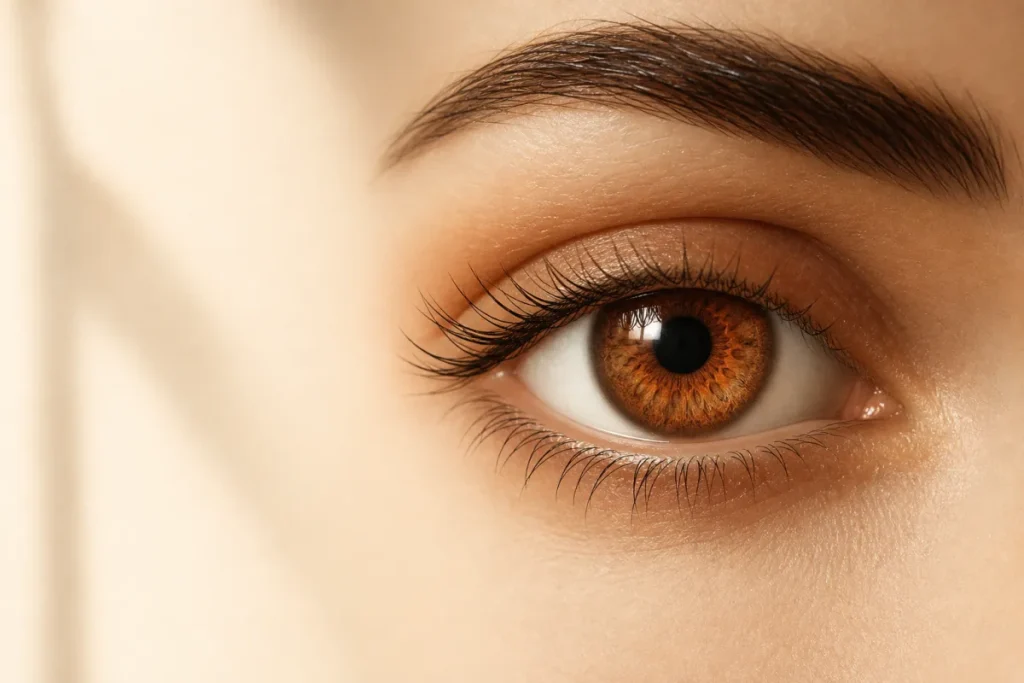
Chestnut eyes are best understood as a warm descriptive shade of brown: they often look medium to deep brown overall, with a coppery, red-brown, golden, or softly russet cast. It is not a separate medical eye-colour category with a fixed boundary. Eye colour is a complex trait shaped by pigmentation and several genes, so informal shade names cannot neatly describe every iris. Source (accessed 2026-11-17)
The useful question is not whether an iris passes a strict “chestnut” test. It is whether its dominant brown reads noticeably warm and red-gold rather than neutral, very dark, green-mixed, or uniformly yellow. If your eyes look plain brown indoors but pick up copper or auburn warmth in soft daylight, chestnut brown may be a helpful description.
What chestnut eyes tend to look like
Think of chestnut as brown with warmth built into the whole impression. The iris may have a cocoa, mahogany, caramel-brown, or muted auburn quality. Fine golden flecks can be present, but flecks alone do not make an eye chestnut; the base colour still reads brown.
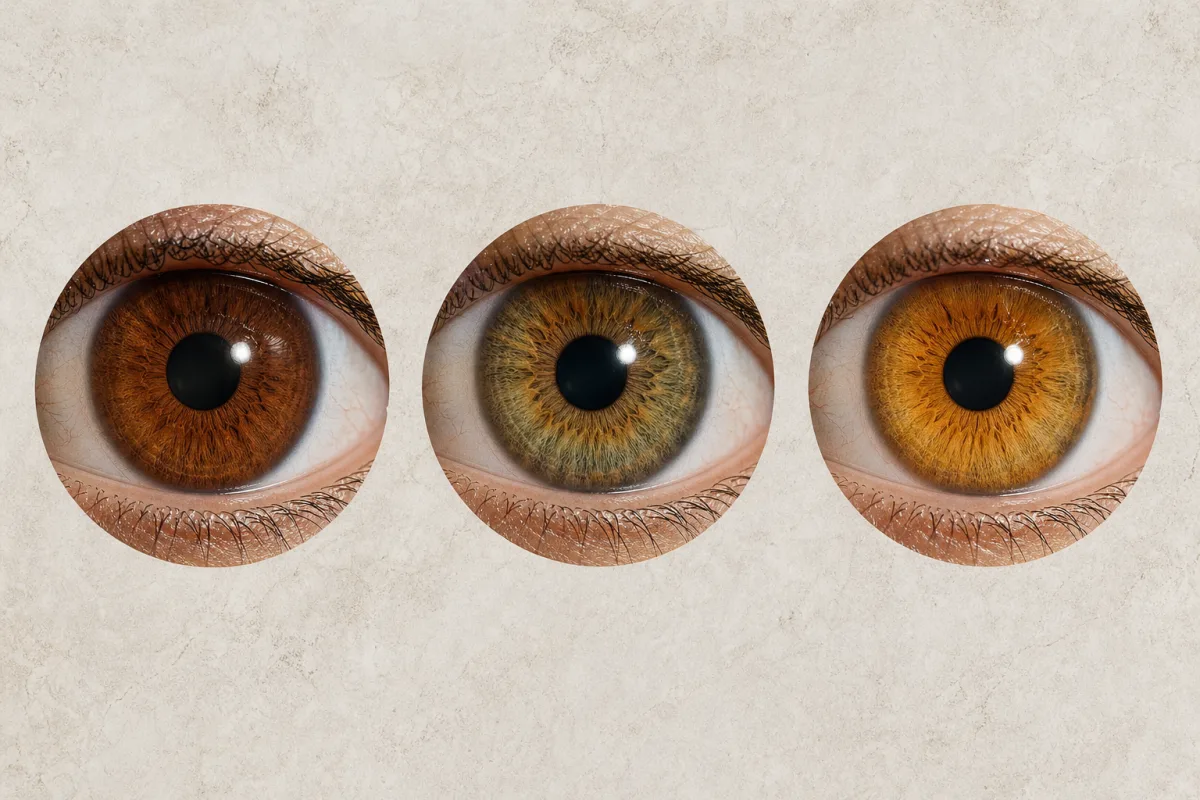
Chestnut eyes can look darker near the pupil or outer rim and warmer through the middle of the iris. Direct sun can bring out gold and copper notes, while shade, a cool room, or a low-exposure camera image can make the same eyes look like ordinary dark brown. That shift is why a single close-up is rarely enough for a confident label.
Chestnut compared with nearby eye shades
| Shade | Overall impression | Useful clue |
|---|---|---|
| Chestnut | Warm brown with copper, red-brown, or muted gold undertones | Brown remains the dominant colour across most of the iris. |
| Medium brown | Brown that may be neutral, cool, or warm | It lacks the distinctly coppery or auburn cast associated with chestnut. |
| Hazel | A visibly mixed look, often involving brown with green, olive, or gold | Green or olive variation is central to the appearance, not just a reflection. |
| Amber | Golden-yellow, honey, or tawny overall | The iris reads more golden than brown. |
| Honey brown | Lighter warm brown with a yellow-gold cast | It usually appears brighter and less red-brown than chestnut. |
| Russet | Deep reddish-brown | It is often used for the redder, earthier end of chestnut-like brown. |
Chestnut and hazel are often confused because both can look warmer in sun. The key distinction is variation: hazel usually needs a visible brown-and-green or brown-and-olive blend to make sense as a label, whereas chestnut can remain consistently brown while changing in warmth. For a closer comparison, see Hazel Eyes: Color, Rarity, Meaning & Examples and Green Eyes vs Hazel Eyes: What Sets Them Apart.
Why the same chestnut iris can look different
There is no single pigment that creates a “chestnut” category. Eye-colour appearance arises from pigmentation in the iris and the way light interacts with its structure; brown eyes generally reflect more melanin-related pigmentation than lighter eyes. Multiple genes contribute to the trait, which is one reason eye colour does not follow a simple one-gene rule. Source (accessed 2026-11-17)
For identification, the immediate conditions matter more than trying to infer biology from a colour name. Warm late-day light may emphasize copper. Cool daylight may mute it. A phone camera can also brighten highlights, deepen shadows, or alter white balance. Makeup, clothing, and the colour of nearby walls can change the perceived undertone without changing the iris itself.
A clearer way to identify a chestnut-brown appearance
- Look in indirect daylight near a window, not under a coloured lamp or direct flash.
- Start with the base: if most of the iris reads brown, keep chestnut in the brown family.
- Look for a repeated warm cast across the iris—copper, auburn, warm gold, or red-brown—not one isolated reflection.
- Check another image taken in different neutral light before settling on a label.
- If green or olive areas remain clearly visible in several conditions, compare hazel as well as chestnut.
A photo can support a description, but it cannot definitively classify a person’s eye colour. The What Color Are My Eyes? Eye Color Identifier App is described as identifying eye colour from a photo; treat any result as a visual starting point and compare it with what you see in neutral light. Source (accessed 2026-11-17)

Choosing a method for naming the shade
Observe in neutral daylight
This is the best option for noticing the iris’s overall brown base and warm undertone without dramatic artificial colour. It suits anyone describing their own eyes in everyday terms. Its drawback is that weather, surroundings, and the angle of light still change what stands out.
Compare several unfiltered photos
Photos taken in different neutral settings can reveal whether copper warmth persists or appears only in one image. This suits people deciding between chestnut, hazel, and amber. It is less useful when the images use filters, flash, strong portrait processing, or different colour temperatures.
Use a photo-based identifier as a second opinion
A photo-based result can give you a convenient vocabulary and a consistent prompt to inspect your image. It suits someone who wants a quick starting label, not a final classification. The limitation is simple: the result is only as representative as the photograph.
My pick is daylight observation followed by a check against several plain photos. It keeps the decision tied to the visible iris rather than to one flattering light source or one label.
Colours that can bring out chestnut warmth
Warm, grounded colours usually make chestnut eyes feel richer: terracotta, muted coral, cinnamon, copper, burgundy, forest green, and creamy ivory are sensible places to start. For makeup, bronze, soft plum, warm taupe, and brown liner can echo the eye’s warmth without demanding that it look more red than it is. Cooler charcoal, navy, or deep teal can create contrast instead, making golden and copper hints more noticeable.
These are styling choices, not rules. The same shade can look very different against skin tone, hair colour, and ambient light. A small swatch held near the face is more informative than a universal colour chart.
Chestnut-brown contact lenses need a safety-first approach
Chestnut-brown lenses can create a warmer brown effect, but no lens will reproduce every natural iris pattern or react to light exactly like an uncovered eye. Prioritize fit, comfort, and legitimate eye-care guidance over a precise shade name. In the United States, decorative contact lenses are regulated medical devices and require a prescription; the FDA also warns against buying lenses without one or sharing lenses. Source (accessed 2026-11-17)
If the distinction you are weighing is more golden than brown, compare your result with Amber-Brown Eyes: Amber or Brown? and Amber Eyes: What Makes This Color So Uncommon before choosing a lens colour.
Small choices that make chestnut undertones easier to see
- Use a plain grey, white, or muted background for photos. It reduces colour cast from bright walls, clothing, or filters.
- Turn off beauty filters and flash. They can smooth iris detail, exaggerate highlights, or change the apparent warmth of brown.
- Compare one eye at a time in indirect daylight. This makes it easier to judge the dominant base colour rather than reflections across the whole face.
- Try warm and cool clothing near your face. Copper and gold may stand out beside teal or navy, while terracotta and burgundy can reveal how naturally warm the brown already is.
- Describe what persists, not what appears in one sunbeam. A stable brown base with recurring warmth is more useful evidence for “chestnut” than a brief golden flash.
Chestnut is more useful as a description than a verdict
People tend to overrate the idea that every iris must fit one exact label, and underrate the role of light, surroundings, and ordinary variation within brown eyes. “Chestnut” earns its place when it helps communicate a warm brown impression; it does not need to be a formal category to be useful. My concrete recommendation: check your eyes in indirect daylight and describe the dominant brown first, then add chestnut only if coppery or red-gold warmth keeps showing up.
Questions people ask about chestnut eyes
Are chestnut eyes brown, hazel, or amber?
Chestnut is usually a description within the brown spectrum. Hazel generally has a more obvious brown-and-green or brown-and-olive mix, while amber reads more golden-yellow overall.
Are chestnut eyes rare?
There is no reliable universal prevalence figure for “chestnut” because the label is informal and its boundaries vary. It is more accurate to call it a warm brown description than to rank it as a separately measured eye colour.
Can chestnut eyes look hazel in sunlight?
They can look lighter, more golden, or more complex in bright light. That alone does not make them hazel; look for persistent green or olive variation in neutral conditions.
Do chestnut eyes have a special meaning?
Colour symbolism and personality claims are cultural interpretations, not a dependable way to learn anything factual about a person. The meaningful part of the label is its visual description.
Can a photo reliably identify chestnut eyes?
A photo can offer a useful comparison, but lighting, exposure, editing, and reflections limit certainty. Check more than one neutral-light image and compare it with your direct view.